
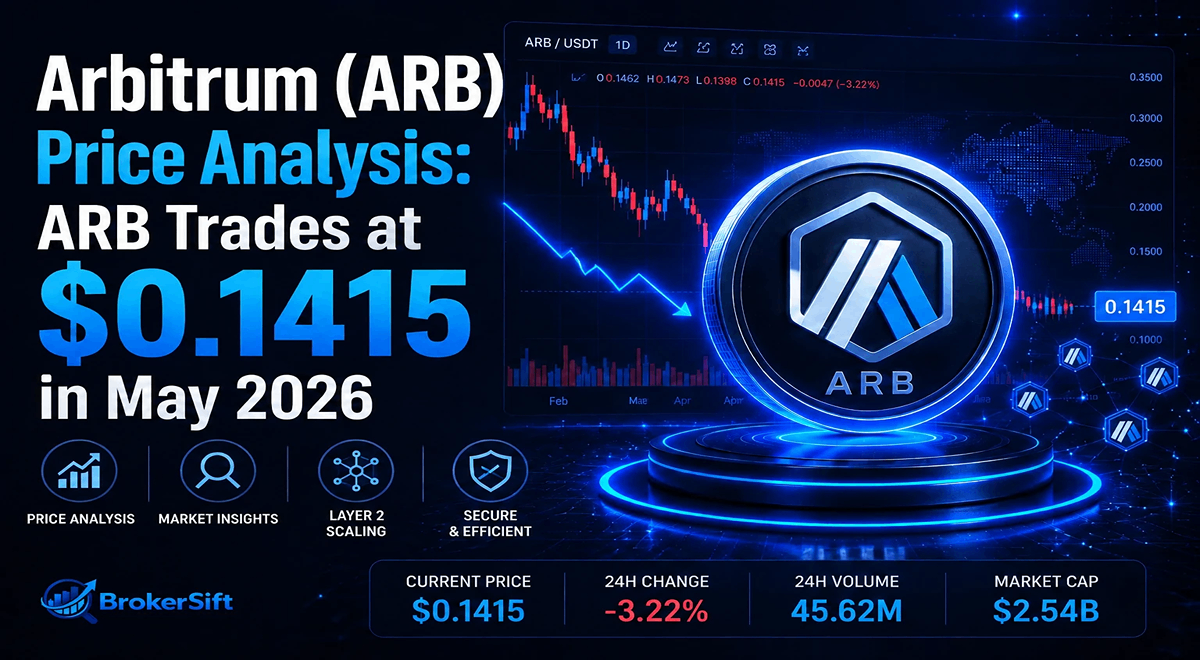
Arbitrum (ARB) trades at $0.1415, up 19.5% in 7 days. We examine price levels, ecosystem fundamentals, and what traders are monitoring closely.
Arbitrum’s native token Arbitrum (ARB) Price Analysis is changing hands at $0.14151 on May 11th, 2026, holding near the upper end of its recent range as the Ethereum layer-2 sector draws renewed attention from traders rotating out of large-cap positions. The token is sitting approximately 94% below its all-time high of $2.39, a figure that underscores just how far sentiment has shifted since the euphoria surrounding its 2023 airdrop launch — yet the past seven days have brought a meaningful recovery, with ARB posting a 19.5% gain over that window, making it one of the more notable movers among established layer-2 assets this week. In the following, stay with BrokerSift to read and find out more about Arbitrum (ARB) Price Analysis.
Price Action and Key Levels
In the past 24 hours, ARB has traded within a relatively tight band, with a session low of $0.140144 and a high of $0.145808 — a range of roughly 4%, suggesting traders are absorbing recent gains rather than pushing aggressively in either direction. The token is currently sitting just above the lower end of that intraday range, which could indicate some consolidation pressure after the sharp weekly move.
The 24-hour trading volume came in at $107.2 million, a figure that points to genuine participation in the current move rather than thin-market noise. With a market capitalisation of $870.2 million and a CoinGecko rank of 80, ARB remains a liquid, mid-cap asset that institutional desks and active retail traders can access with relative ease. The key technical question for short-term participants is whether the $0.140 area — which roughly aligns with the session low — can hold as near-term support. A sustained break below that level would likely prompt reassessment of the weekly rally’s durability.
You can buy and sell ARB on the Binance exchange through this link Binance.

Project Fundamentals and Ecosystem
Arbitrum operates as an optimistic rollup on Ethereum, processing transactions off-chain before settling them on the base layer. This architecture has made it one of the most actively used Ethereum scaling solutions by total value locked and transaction throughput. The Arbitrum One mainnet continues to host a broad array of decentralised finance protocols, perpetuals platforms, and gaming applications, while Arbitrum Nova — the chain optimised for high-frequency, low-cost interactions — has attracted gaming studios and social applications seeking near-zero fees.
The Arbitrum DAO, which governs the network through ARB token holders, has been an active participant in on-chain governance since the token’s launch. Grant programmes under the Short-Term Incentive Programme and its successors have directed capital toward ecosystem projects, with the explicit goal of deepening liquidity and developer activity on-chain. Arbitrum competes most directly with Optimism’s OP Mainnet and Base, the Coinbase-incubated chain built on the OP Stack.
While Base has gained ground in terms of transaction volume, Arbitrum has maintained competitive TVL figures and benefits from a longer track record of EVM compatibility and security.
One structural consideration for ARB holders who needs to know news about Arbitrum (ARB) Price Analysis is the ongoing token unlock schedule, which has periodically introduced supply-side pressure since the original distribution. Tracking upcoming unlock tranches remains a practical part of any fundamental assessment of the token.
| Year | Market Demand Level | Key Market Condition | Investor Behavior |
|---|---|---|---|
| 2023 | Very High | Airdrop launch hype & speculation | Massive retail inflow, high volatility |
| 2024 | High | Ecosystem expansion phase | Active trading, DeFi growth interest |
| 2025 | Medium | Market correction & unlock pressure | Reduced speculation, selective accumulation |
| 2026 | Rising (Recovering) | Layer-2 narrative revival | Gradual return of traders & rotation capital |
What Traders Are Watching
Beyond the immediate Arbitrum (ARB) Price Analysis, market participants are keeping a close eye on broader Ethereum layer-2 sentiment, which has been sensitive to shifts in ETH’s own price trajectory and to developments around Ethereum’s roadmap for further scaling improvements. Any meaningful update from the Ethereum Foundation or progress on proposals that affect rollup economics tends to have an outsized effect on tokens like ARB. If you want to find the best broker for trading on ARB you can read our article with this topic “How to find the best broker?”
On-chain analysts are also monitoring Arbitrum’s daily active address counts and sequencer revenue as leading indicators of genuine usage growth versus speculative positioning. Periods where price moves are not accompanied by corresponding on-chain activity have historically been shorter-lived for this asset class.

As of this writing about Arbitrum (ARB) Price Analysis, ARB presents a picture of measured recovery within a broader multi-year downtrend from its peak. The 19.5% weekly gain is a data point worth tracking, but market participants would be well-served to weigh it alongside volume trends, unlock schedules, and the competitive dynamics of an increasingly crowded layer-2 sector before drawing firm conclusions.
In Conclusion
Arbitrum is one of the leading Ethereum Layer 2 solutions, designed to improve scalability by offering faster transactions and lower fees while relying on Ethereum’s security. Its growing adoption in DeFi and Web3 makes it an important infrastructure project in the crypto ecosystem.
However, ARB remains a volatile asset influenced by market trends, token unlocks, and competition among Layer 2 networks, so risk management is essential for investors.Overall, Arbitrum is a strong long-term infrastructure project with significant growth potential as Ethereum scaling demand increases.
Arbitrum (ARB) Price Analysis shows that staying updated with market conditions is key for better trading decisions.At BrokerSift, we help you stay ahead with the best global market insights and daily professional analysis.
Can Arbitrum reach $100 dollars?
Arbitrum reaching $100 would require an extremely large market capitalization far beyond most current Layer 2 crypto projects. While Arbitrum is one of the leading Ethereum scaling networks with strong adoption in DeFi, gaming, and Web3, a $100 ARB price would likely require massive long-term growth, widespread institutional adoption, and a major expansion of the Ethereum ecosystem. Crypto prices are highly volatile, so future price performance remains speculative.
Is Arbitrum L1 or L2?
Arbitrum is a Layer 2 (L2) blockchain built on top of Ethereum. It uses Optimistic Rollup technology to process transactions faster and with lower fees while still benefiting from Ethereum’s security. Arbitrum is not a Layer 1 blockchain like Ethereum or Solana — it is specifically designed to scale Ethereum.
Why is Arbitrum falling?
Arbitrum price declines can happen for several reasons including overall crypto market weakness, Bitcoin volatility, token unlock events, investor profit-taking, lower network activity, or negative macroeconomic sentiment. Like most altcoins, ARB is heavily influenced by broader market conditions and Ethereum ecosystem trends. Regulatory news and Layer 2 competition can also impact ARB price performance.
Is Arbitrum under Ethereum?
Yes. Arbitrum operates on top of Ethereum as a Layer 2 scaling network. It relies on Ethereum for security, settlement, and decentralization while helping reduce congestion and gas fees on the Ethereum mainnet. Transactions on Arbitrum are ultimately validated through Ethereum infrastructure.
Share your view about “Arbitrum (ARB) Price Analysis: ARB Trades at $0.1415 in May 2026” in the comment section.
Your email stays private. Thoughtful takes and respectful disagreement are welcome.